

This is one chapter of a broader Implementation Guide on providing accessible healthcare for people with disabilities. The chapter will guide you through creating a foundation for accessibility in your organization. We recommend reviewing this chapter before implementing other chapters in this guide. The information in this chapter is a synthesis of existing research and learnings from health systems across the country. This information is intended to provide guidelines adaptable to your local context.
This chapter includes: 1) an introduction to the topic, 2) six steps for implementation, and 3) a variety of appendices. Under each step, the Actions and Tasks section outlines best practices and questions to consider while creating and implementing an accessibility program at your organization. The Materials and Resources section lists the relevant appendices, which include worksheets, templates, examples, and other resources to assist you in completing the Actions and Tasks of each implementation step.
Appendices can also be used independently. For example, you could use Appendix 1.4: Accessibility Program Costs and Funding if you are only interested in understanding the items and activities associated with an accessibility program in a health system that may need allocated funding.
Accessible care affects all aspects of care delivery. Whether you represent a standalone clinic, a hospital, or a health network, providing accessible healthcare to patients with disabilities requires integrated action across your entire organization. This chapter provides practical steps for establishing a disability accessibility program at your organization.
There are six components to building an accessibility program:
- Engage the Disability Community
- Develop Leadership Support
- Conduct Needs Assessment
- Define Activities of the Program
- Determine Organizational Structure
- Implementation Planning
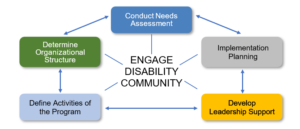
We have situated these components in a non-linear fashion.
Your sequence of steps will depend on your position within the organization and your organizational needs. You may also need to re-visit steps. For example, you might need to start with gaining leadership support to begin a Needs Assessment process. After you conduct your Needs Assessment, you might need to return to leadership to gain additional support to define your program. If any of the building blocks or parts of a section are not applicable to your organization, it may be skipped.
Core Components of Building a Disability Accessibility Program
Implementing accessible care for patients with disabilities starts with engaging people with disabilities within your community and organization. Navigating healthcare as someone with a disability is best understood by people with disabilities. Engaging people with disabilities will build trust, inform your understanding, and ensure you meet your community’s needs.
Actions and Tasks
- Include people with disabilities and caregivers of people with disabilities into existing patient advisory boards.
- Consider developing a disability-specific patient advisory board.
- Solicit feedback from patients with disabilities about the quality of care delivered within your organization.
- Solicit feedback from people with disabilities in your community about challenges they may face when accessing care at your organization.
- Feedback could be collected by integrating disability accessibility questions in patient feedback surveys, focus groups, listening sessions, sharing circles, or partnerships with local disability groups.
- Ensure there are multiple opportunities and modalities for providing feedback.
- Review existing feedback and complaints from patients with disabilities.
- If available, engage your disability employee resource or affinity group.
- Share accommodation and accessibility features at your organization with your community through community seminars, conferences, or other means.
- Partner with and support the visibility of nearby disability organizations to build trust with your local disability community.
- For example, invite an organization to set up a booth in your clinic or hospital to advertise their services.
- Ensure marketing and communication materials are inclusive and representative of people with disabilities. Use appropriate disability language.
Across all efforts, it is important to engage people across varying types of disabilities, racial and ethnic identities, sexual and gender identities, levels of health literacy, age groups, as well as caregivers of people with disabilities.
Materials and Resources
- Appendix 0.1: Definitions↗
- Appendix 0.2: Appropriate Disability Language↗
- Appendix 0.4: Disability Organizations↗
- Effectively Including People with Disabilities in Policy and Advisory Groups↗
- Creating an Accessibility Committee↗
- Creating Family and Patient Advisory Councils↗
Appendices 0.1, 0.2, and 0.4 can be accessed in the General Resources chapter↗.
Building an accessibility program requires system level engagement, including support from your organization’s leadership. Leadership support will ensure you have the necessary resources to make meaningful change. You will likely need to continue to engage leadership throughout building and sustaining the accessibility program. Each of the subsequent chapters in this guide includes suggestions to engage leadership.
Actions and Tasks
- Identify what types of leadership support and buy-in you will need.
- Identify potential champions across your organization.
- Often, champions are individuals who work in disability specific disciplines (e.g., rehabilitation), are people with disabilities, or are people who have family members with disabilities.
- Identify how a disability accessibility program will fit within your organization’s existing priorities and initiatives (e.g., health equity, quality and safety, patient experience goals).
- Determine if your organization is involved in regulatory initiatives that align with a disability accessibility program (e.g., Joint Commission Excellent Health Outcomes for All Certification, U.S. Centers for Medicare and Medicaid Services (CMS) requirements, state-level requirements, etc.)
- Identify potential concerns leadership may have and possible solutions.
- Create necessary charters, strategic plans, and presentations to present to leadership and garner their support.
Materials and Resources
- Appendix 0.3: Federal Requirements for Providing Accessible Care↗
- Appendix 0.10: Leadership Support: Key Individuals↗
- Appendix 1.2: Accessibility Program Implementation Planning
- Appendix 1.3: Accessibility Program Barriers and Strategies
- Appendix 1.4: Accessibility Program Costs and Funding
- Appendix 1.5: Accessibility Program Leadership Support Slides Template
Appendices 0.3 and 0.10 can be accessed in the General Resources chapter↗.
Identify the current state of accessibility initiatives and activities at your organization.
Actions and Tasks
- Identify what disability accessibility initiatives are currently happening, including who is leading the work and the department or unit the work is happening within.
- Engage with other healthcare organizations to understand their healthcare accessibility programs, including what is and isn’t working for them. Consider joining the Disability Equity Collaborative’s Leaders workgroup to create a peer network.
Materials and Resources
- Appendix 0.7: Accessibility Screening Tool Template↗
- Appendix 0.8: Disability Accommodations Examples↗
- Appendix 1.1: Accessibility Program Needs Assessment
- Disability Equity Collaborative’s Leaders Workgroup↗
Appendices 0.7 and 0.8 can be accessed in the General Resources chapter↗.
Identify the activities of your accessibility program. Activities could include but are not limited to documenting disability status in the electronic health record (EHR), purchasing accessible diagnostic equipment, and conducting disability competency training. The activities will be informed by your Needs Assessment, engagement with the disability community, institutional priorities and resources, and the structure of your accessibility program.
Actions and Tasks
- Identify existing activities and how they will be incorporated in your new accessibility program.
- Identify new, high priority activities to include in the accessibility program (i.e., those related to legal compliance).
- Identify new, low priority activities that should be implemented in the future.
- Identify current funding and potential funding resources for your activities.
- Review federal, state, and accreditation requirements to ensure your activities are compliant.
Materials and Resources
- Appendix 0.3: Federal Requirements for Providing Accessible Care↗
- Appendix 1.4: Accessibility Program Costs and Funding
- Appendix 1.6: Accessibility Program Activities
- Appendix 1.7: Accessibility Program Activities Priority Worksheet
Appendix 0.3 can be accessed in the General Resources chapter↗.
To establish an accessibility program, your organization will need to determine where the program is situated within the organization at large. This is influenced by available funding and resources, priority activities, and the Needs Assessment.
Actions and Tasks
- Identify department(s) the program will exist in. Consider integrating your accessibility program’s goals and objectives into your organization’s existing quality improvement, patient safety, or population health initiatives.
- Determine if accessibility activities will be driven by a single or multiple departments.
- Determine what position(s) will oversee the accessibility program or the different aspects of the accessibility program.
- Create and post job descriptions as needed.
- Create an advisory committee to oversee the accessibility program. This should include key institutional members, as well as people with disabilities.
Materials and Resources
- Appendix 1.6: Accessibility Program Activities
- Appendix 1.8: Accessibility Program Organizational Structure
- Appendix 1.10: Example Disability Coordinator Job Description
- Effectively Including People with Disabilities in Policy and Advisory Groups↗
- Creating an Accessibility Committee↗
- Creating Family and Patient Advisory Councils↗
Using the information identified in the Needs Assessment, complete the Implementation Planning worksheet to create a plan for developing an accessibility program at your organization.
Actions and Tasks
- Define goals and successful outcomes of your accessibility program. Create a workplan and timeline to achieve your goals.
- Identify how you will measure progress.
- Identify relevant data sources to measure success (e.g., quality and safety data, adverse inpatient outcomes, etc.).
- Identify how you will include patients’ perspectives in your evaluation (e.g., patient experience surveys or focus groups).
- Using Appendix 1.9: Accessibility Program Monitoring Progress and Adaptations, execute and document any needed adaptations.
- Federal, state, and accreditation requirements update frequently. Closely monitor these requirements to ensure your program is compliant.
Materials and Resources
- Appendix 0.6: Project Planning↗
- Appendix 1.1: Accessibility Program Needs Assessment
- Appendix 1.2: Accessibility Program Implementation Planning
- Appendix 1.7: Accessibility Program Activities Priority Worksheet
- Appendix 1.9: Accessibility Program Monitoring Progress and Adaptations
Appendix 0.6 can be accessed in the General Resources chapter↗.
| NAME | DESCRIPTION |
| Appendix 1.1: Accessibility Program Needs Assessment (PDF, 939 KB)↗ | A worksheet to review the current landscape of the organization, identify gaps and strengths, and identify specific goals for the accessibility program. |
| Appendix 1.2: Accessibility Program Implementation Planning (PDF, 586 KB)↗ | A worksheet to identify the future direction and processes that will be followed when developing an accessibility program. |
| Appendix 1.3: Accessibility Program Barriers and Strategies (PDF, 532 KB)↗ | Lists possible barriers to developing an accessibility program and potential implementation strategies that could address those challenges. |
| Appendix 1.4: Accessibility Program Costs and Funding (PDF, 325 KB)↗ | Lists the expenses to consider that are associated with an accessibility program in a health system, as well as possible sources for health systems to leverage in identifying funding resources. |
| Appendix 1.5: Accessibility Program Leadership Support Slides Template (PDF, 501 KB)↗ | A slide deck template that can be used by health systems to present to leadership to garnish leadership support for accessibility initiatives. |
| Appendix 1.6: Accessibility Program Activities (PDF, 399 KB)↗ | A list of all the possible initiatives, activities, and tasks of a disability accessibility program in a healthcare organization. |
| Appendix 1.7: Accessibility Program Activities Priority Worksheet (PDF, 290 KB)↗ | A worksheet to prioritize program activities by: existing activities; high priority/need for immediate implementation; low priority/future implementation. |
| Appendix 1.8: Accessibility Program Organizational Structure (PDF, 393 KB)↗ | Describes possible organizational structures for the disability accessibility program. |
| Appendix 1.9 Accessibility Program Monitoring Progress and Adaptations (PDF, 388 KB)↗ | A worksheet to track progress and adaptations to the implementation plan. |
| Appendix 1.10: Example Disability Coordinator Job Description (PDF, 490KB)↗ | Sample responsibilities and qualifications to include in a Disability Coordinator job description. |
Chapter 1: Building a Disability Accessibility Program was supported by the WITH Foundation under award number 233752. Under this award, an advisory board was convened to support the development of this chapter. Advisory board members included Zary Amirhosseini, Dr. Kara Ayers, Lindsay Baran, Sherri Rita, Dr. J.R. Rizzo, Adreinne Robertiello, Sarah Triano, Wendy Sultzman, Hope Collins, and Rebecca Zickerman.
We would also like to express our gratitude to Kori Eberle, Jennifer Halfacre, Lynne Brady Wagner, and Ellie Mellor for their contributions and review of this chapter. Additionally, we would like to thank the members of DEC’s Leaders workgroup and Standards & Guidelines workgroup for their input and suggestions.
additional CHAPTERS

Large print version available upon request.
Additional chapters are in development.